What’s the Difference Between Tempered Glass and Laminated Glass?
If you’ve ever gotten a quote for a window or door replacement in Toronto and seen the terms “tempered” and “laminated” listed as options, you’ve probably wondered whether it actually matters which one you choose, or if it’s just industry jargon that all means the same thing in the end. It’s a fair question, and it’s one we get asked constantly, especially from homeowners dealing with large picture windows, patio doors, or anyone who’s recently read about building code requirements for safety glass.
The short answer is that tempered and laminated glass are both considered “safety glass,” but they behave completely differently when they break, and that difference matters a lot depending on where the glass is being used. If you’re weighing your options for an upcoming project, our glass repair and replacement services page is a good place to start, but let’s walk through exactly what sets these two products apart first.
1. What Tempered Glass Actually Is
Tempered glass, sometimes called toughened glass, is regular annealed glass that’s been heated to a very high temperature and then rapidly cooled. This process, known as tempering, changes the internal structure of the glass, putting the outer surfaces into a state of compression while the interior remains in tension.
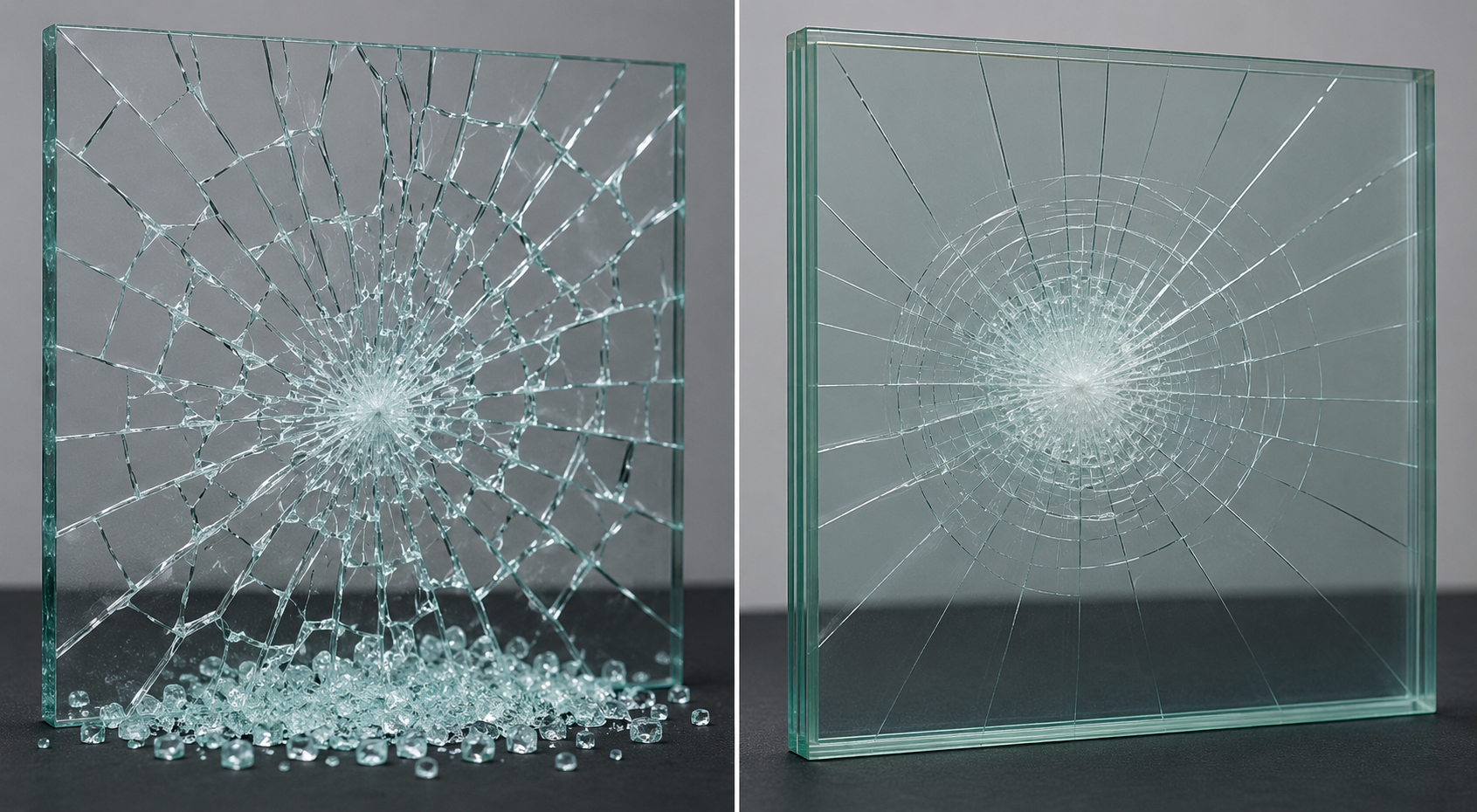
The result is glass that’s roughly four to five times stronger than standard glass of the same thickness. It can withstand significantly more impact, temperature stress, and pressure before breaking. But here’s the important part: when tempered glass does finally break, it shatters into small, relatively blunt pebble-like pieces rather than long, jagged shards.
This is why you’ll often see tempered glass required by building code in specific high-risk locations, since the goal is to prevent dangerous, sharp shards if the glass does fail.
2. What Laminated Glass Actually Is
Laminated glass takes a different approach entirely. Instead of relying on a heat-treatment process to strengthen a single pane, laminated glass is made by bonding two or more layers of standard glass together with a durable interlayer, most commonly a material called PVB (polyvinyl butyral), sandwiched between them.
When laminated glass breaks, the glass itself can crack, sometimes extensively, but the interlayer holds the broken pieces in place rather than letting them fall away or scatter. Instead of a clean, shattered break, you end up with a cracked but intact sheet still held together by that inner layer, similar in concept to a car windshield, which is actually the most common everyday example of laminated glass.
This single property, holding together after impact rather than falling apart, is what makes laminated glass so valuable for security, sound reduction, and UV protection applications.
3. The Core Difference: How Each One Fails
This is really the heart of the comparison, so it’s worth spelling out clearly.
| Factor | Tempered Glass | Laminated Glass |
|---|---|---|
| Break pattern | Shatters into small, blunt pieces | Cracks but stays held together by interlayer |
| Strength before breaking | Roughly 4–5x stronger than standard glass | Similar strength to standard glass, but performs better after impact |
| Security value | Low once broken; opening becomes accessible | High; glass stays in the frame, delaying entry |
| Sound dampening | Minimal improvement over standard glass | Noticeably better due to the interlayer |
| UV protection | Minimal | Blocks up to 99% of UV rays in most products |
| Typical uses | Shower doors, patio doors, tabletops, low sills | Storefronts, skylights, security-sensitive openings, sound-sensitive rooms |
| Cost | Generally more affordable | Generally higher upfront cost |
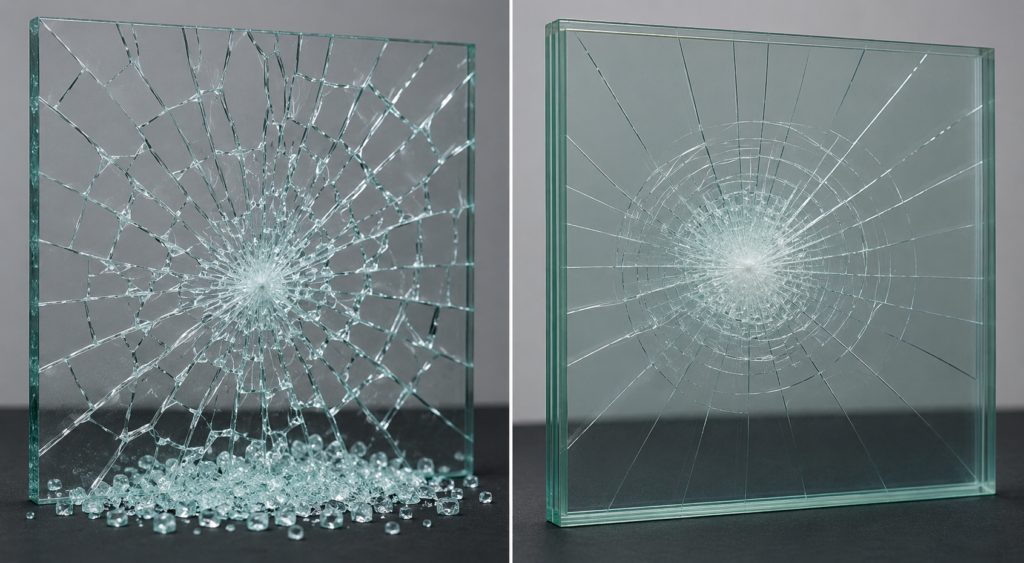
Neither option is universally “better.” They’re built to solve different problems, and the right choice depends entirely on where the glass is going and what you’re trying to protect against.
4. Where Tempered Glass Makes the Most Sense
Tempered glass is the standard choice, and often the code-required choice, in a number of common residential and commercial applications:
- Shower and bathtub enclosures
- Sliding and swinging patio doors
- Glass close to the floor, such as low windows or sidelights near a walking surface
- Tabletops and shelving
- Glass railings and balustrades
The priority in these locations is reducing injury risk if the glass breaks, and tempered glass’s small, blunt fragments do that effectively. It’s also generally more budget-friendly than laminated glass, which makes it the practical default for applications where security or sound isn’t the primary concern.
5. Where Laminated Glass Makes the Most Sense
Laminated glass tends to be the better choice anywhere that keeping the glass intact after an impact, rather than just breaking safely, is the priority:
- Storefront windows and ground-floor commercial glass
- Skylights, where falling glass shards would be a serious hazard
- Homes or offices near busy Toronto streets, where sound reduction is a priority
- Security-conscious openings, including entry doors and street-facing windows
- Rooms with significant sun exposure, where UV and fading protection matters
For homeowners and business owners across Toronto who’ve dealt with attempted break-ins, or who are simply trying to reduce road and traffic noise in a busier part of the city, laminated glass often ends up being the better long-term investment, even with the higher upfront cost.
If you’re evaluating which option makes sense for a property here, our glass repair and replacement services across the Greater Toronto Area page covers both options in more detail, along with what we typically recommend for different building types.
6. Can You Combine Both in the Same Window?
Yes, and in some commercial and high-security applications, this is actually common practice. Some glass units are built using both a tempered outer layer and a laminated inner layer, combining the impact resistance of tempering with the “stay together” performance of lamination.
This tends to show up most often in higher-end storefront systems, security-sensitive commercial buildings, and occasionally in high-performance residential glazing where both strength and post-break integrity are priorities. It’s a more specialized (and more expensive) option, so it’s usually reserved for specific situations rather than standard residential replacements.
7. A Common Myth: “Tempered Glass Is Always Safer”
This is one of the most common misconceptions we run into. Tempered glass is safer in the sense that it doesn’t produce long, dangerous shards when it breaks. But “safer” doesn’t always mean “better protected.”
If your priority is preventing an opening from becoming accessible after the glass breaks, whether that’s due to a break-in attempt, storm debris, or an accidental impact, tempered glass actually performs worse than laminated glass in that specific scenario. Once tempered glass shatters, the opening is immediately open. Laminated glass, even cracked, often stays in place long enough to buy time or prevent entry altogether.
The right answer depends entirely on what risk you’re trying to reduce: injury from sharp shards, or unauthorized access through a broken opening.
Key Terms Worth Knowing
Annealed Glass: Standard, untreated glass that breaks into large, sharp shards. Both tempered and laminated glass start from annealed glass before being processed further.
Interlayer (PVB): The flexible plastic layer, typically polyvinyl butyral, sandwiched between panes of glass to create laminated glass.
Compression/Tension Layers: The internal stress structure created during the tempering process, which gives tempered glass its added strength.
Safety Glass: A general term referring to any glass engineered to reduce injury risk compared to standard annealed glass, which includes both tempered and laminated types.
Impact Rating: A classification used to describe how much force a glass product can withstand before failing, often relevant for storefronts and security applications.
How to Decide Which One Is Right for Your Project
If you’re not sure which type of glass makes sense for your specific windows or doors, a few simple questions can usually point you in the right direction:
- Is this glass close to a walking surface or in a high-traffic area? Tempered is often the code requirement.
- Is this a ground-floor window, storefront, or entry point you’re concerned about securing? Laminated is usually the better fit.
- Is traffic noise or sound transfer a concern? Laminated glass offers a real advantage here.
- Is budget the primary constraint, and the location isn’t security-sensitive? Tempered is typically the more cost-effective choice.
For most residential projects, the decision comes down to a straightforward trade-off between upfront cost and the specific performance you need. For commercial and storefront applications, code requirements and security concerns often make the decision for you.
Why Choose Revitalize Windows & Doors Inc
We work with both tempered and laminated glass regularly across residential and commercial properties throughout Toronto, and we always start by understanding what problem you’re actually trying to solve before recommending a product. A homeowner replacing a shower enclosure has very different needs than a business owner reinforcing a storefront, and we treat those conversations differently from the start.
How We Can Help You Today
- Tempered glass replacement for showers, patio doors, and low-sill windows
- Laminated glass installation for storefronts, skylights, and security-sensitive openings
- Combined tempered-laminated glass units for high-performance applications
- Glass assessment to determine which option fits your specific project and budget
- Full-service glass repair and replacement across residential and commercial properties
Frequently Asked Questions
Is laminated glass stronger than tempered glass? Not exactly. Tempered glass is generally stronger before it breaks, but laminated glass performs better after impact, since it stays held together rather than falling apart.
Which type of glass is required by code for patio doors? Tempered glass is typically required for patio doors and other glass close to walking surfaces, since it reduces injury risk if the glass breaks.
Can laminated glass be repaired if it cracks, or does it need full replacement? In most cases, once laminated glass cracks, the full unit needs to be replaced, since the interlayer that gives it strength can’t be repaired on its own.
Does laminated glass really reduce outside noise? Yes, the interlayer in laminated glass provides noticeably better sound dampening compared to standard or tempered glass, which makes it a popular choice for homes and offices in busier parts of Toronto.
Is one option better for energy efficiency? Laminated glass tends to offer a slight edge due to its additional layer and UV-blocking properties, though for significant energy efficiency gains, the overall window assembly and glazing type matter more than tempered versus laminated alone.
Ready to Choose the Right Glass for Your Project?
Whether you’re replacing a single window or reinforcing an entire storefront, we’re happy to walk you through which type of glass makes the most sense for your specific situation. Contact us directly to request your free quote, and we’ll help you make the right call.