
How Do I Change the Door Closer on My Commercial Door in Toronto and the GTA?
Meta description: Learn how to change a commercial door closer step by step, what it costs, and when to call a pro. A practical guide for Toronto and GTA businesses.
If your commercial door slams shut, hangs open, or drifts closed so slowly that customers get stuck holding it, the door closer is almost always the culprit. Here is the short answer to the question we hear from Toronto and GTA business owners all the time: yes, you can change a commercial door closer yourself if it is a standard surface-mounted unit on a non-fire-rated door, and it usually takes one to two hours. If it is a concealed, floor-mounted, or fire-rated setup, you will want a professional.
We are going to walk through the whole job honestly, including the parts that trip people up, so you can decide what makes sense for your storefront, office, restaurant, or building.
First, Do You Actually Need a New Door Closer?
Before you buy anything, confirm the closer is really the problem. A door that will not close properly can also be caused by a sagging hinge, a warped frame, a misaligned strike plate, or a blocked latch. We have seen plenty of Toronto businesses replace a perfectly good closer when the real issue was a loose hinge screw.
Signs the closer itself has failed:
- Oil leaking from the body or arm. Hydraulic fluid on the door or floor means the seals have given out, and no amount of adjusting will fix that.
- The door slams even after you turn the speed valves all the way down.
- The door will not latch, or it stops a few centimetres short of the frame every time.
- Jerky, uneven movement through the swing instead of a smooth, controlled close.
- A bent or cracked arm, or a body that wobbles on its bracket.
- The door is simply old. A busy commercial closer on a downtown Toronto storefront can cycle hundreds of times a day. After ten to fifteen years, most are tired.
If the closer is only slow or fast, try adjusting first. Most units have two or three small valve screws on the body that control sweep speed, latch speed, and backcheck. A quarter turn at a time is plenty. If adjusting does nothing, or the fluid is leaking, replacement is the right call.
Know Which Type of Door Closer You Have
This decides how hard the job will be, so take a minute to identify it.
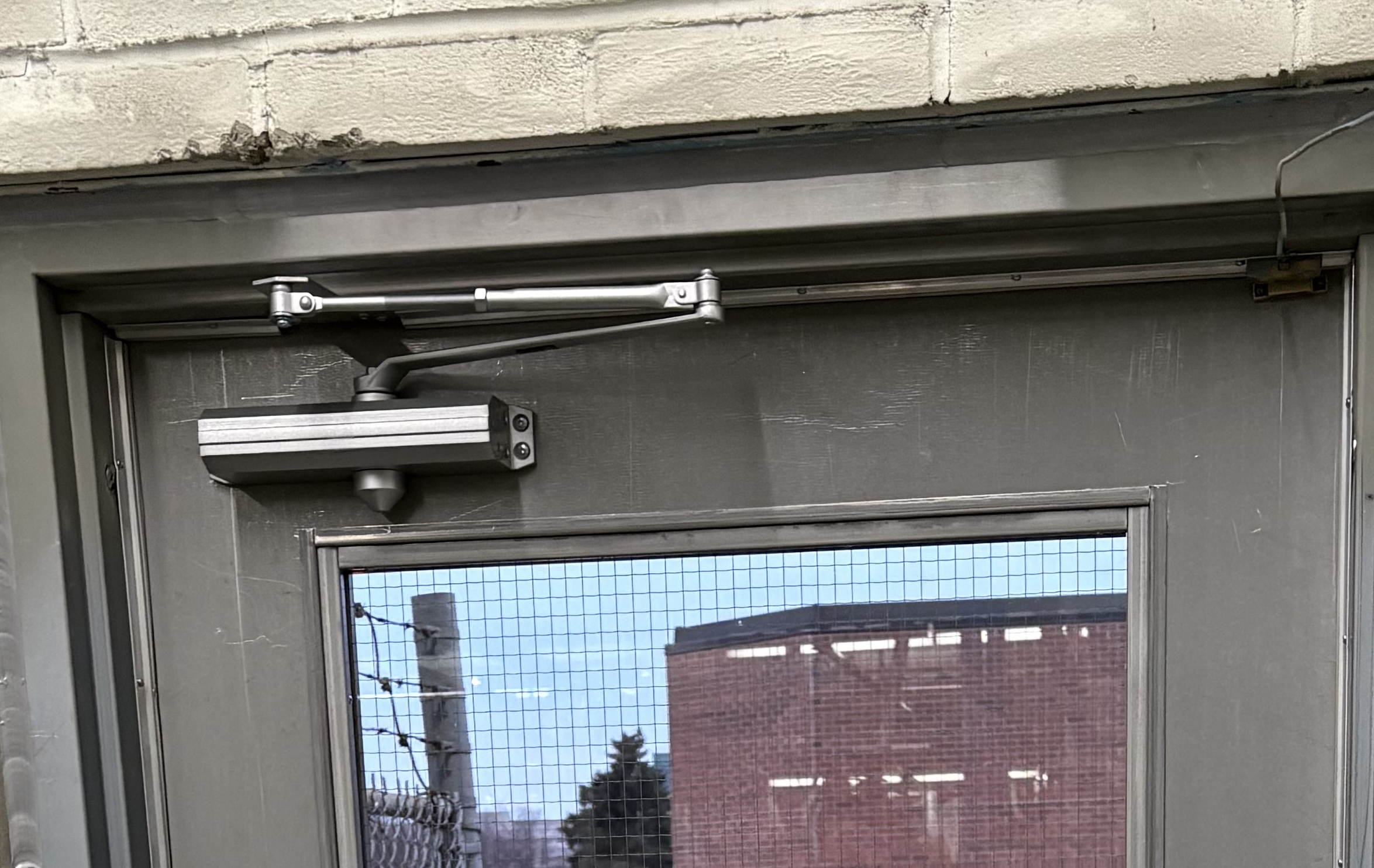
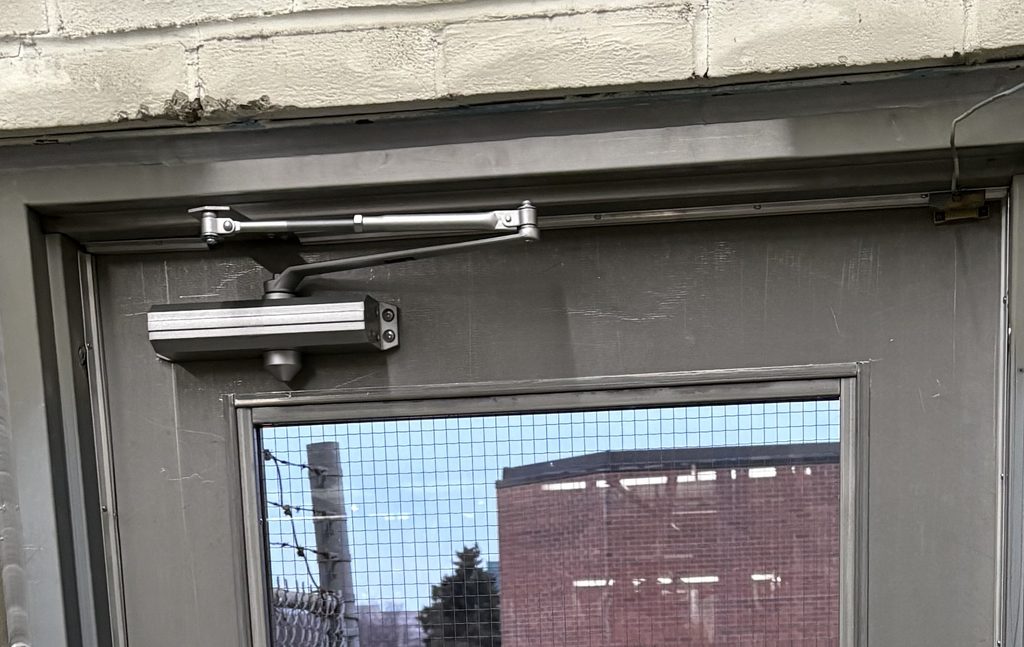
Surface-mounted closers are the most common. The body sits on the door or frame, and an arm connects it to the opposite side. These are the easiest to swap and what most of this guide covers.
Concealed closers are built into the top of the door or the frame, so only a small piece of the arm shows. They look cleaner but take more skill to remove and replace.
Floor-mounted closers (often called floor springs) sit in a cavity in the floor under the door, common on glass entrance doors. Replacing one usually means lifting the door and working below floor level. We recommend leaving these to a professional.
Overhead-concealed and rack-and-pinion styles are less common, but you will see them in some older Toronto buildings.
Also look for a label or stamp on the body. It will usually show the manufacturer, model number, and a size rating. That size number matters more than most people realize.
Get the Size and Spec Right Before You Buy
Commercial door closers are rated by size, usually from 1 to 6, based on door width and weight. A heavy exterior door needs a higher size than a light interior door. Installing a closer that is too small means the door will not close reliably, especially with Toronto’s winter wind pushing against it or stack-effect pressure in a taller building. Installing one that is too big makes the door hard to open, which is a real problem for accessibility.
Measure your door width and note whether it is interior or exterior, hollow metal, wood, or aluminum-and-glass. If your old closer is still readable, matching the brand and model is the simplest route, because the mounting holes will line up and you avoid drilling new ones.
A quick note on codes: entrances that need to be accessible have limits on how much force it takes to open the door, and fire-rated doors must close and latch on their own. If your door is fire-rated, do not wedge it open, do not remove the closer, and do not swap in something that is not rated for it. When in doubt, ask a professional before you touch it.
What You Will Need
Most closer swaps need only basic tools:
- Cordless drill and bits
- Screwdrivers (Phillips and flathead)
- Hex keys (Allen wrenches)
- Tape measure and pencil
- The manufacturer’s mounting template, which comes in the box
- A ladder or sturdy step stool
- A helper to hold the door if it is heavy
- Replacement screws, in case the old holes are stripped
Step-by-Step: How to Replace a Surface-Mounted Commercial Door Closer
1. Prop the door and protect the area. Open the door and secure it so it cannot swing while you work. Clear the floor of foot traffic. If it is a customer-facing door, put up a sign and direct people to another entrance.
2. Note the current position. Take a photo of the old closer from a few angles. Pay attention to whether the body sits on the door (regular arm mount), on the frame (top jamb mount), or on the hinge side or opposite side. You want your new closer to match unless you are deliberately changing it.
3. Loosen the arm first. Disconnect the arm from the body by removing the screw or nut at the joint. This releases tension so the closer is not fighting you.
4. Remove the body, then the arm bracket. Unscrew the body from the door or frame. Support it with one hand as the last screw comes out because these units are heavier than they look. Then remove the arm bracket or shoe.
5. Compare old and new. Set the new closer beside the old one. If the mounting holes match, great. If not, fill or plan around the old holes.
6. Use the template. Tape the paper template to the door or frame, line it up with the edge, and mark the new drill points. Do not eyeball this. A closer that is even a few millimetres off will bind, close unevenly, or wear out early.
7. Drill pilot holes. Use the correct bit for your door material. Metal doors need a tapping approach or self-tapping screws. Wood needs a pilot hole to avoid splitting. On aluminum and glass doors, be very careful, because the profile is thin and there may be limited mounting area.
8. Mount the body. Secure the closer to the door or frame with the supplied screws. Snug them evenly, but do not overtighten.
9. Attach the arm and bracket. Install the arm bracket on the opposite surface, then connect the arm to the body. Many arms have a “preload” step, where you turn the arm to set spring tension before you tighten the final screw. Follow the instructions that came with your model, since this differs by manufacturer.
10. Set the sweep and latch speeds. With the arm connected, open and release the door. Watch the closing motion. The main sweep should be steady and controlled through most of the swing, then the latch speed should give a firm final push of the last 10 to 15 degrees. Use the valve screws to adjust, a quarter turn at a time.
11. Adjust backcheck if needed. Backcheck is the cushioning that slows the door near full open, protecting the wall and the hinges from someone pushing hard or wind grabbing the door. If your door tends to swing wide in Toronto’s gusty weather, this setting is worth getting right.
12. Test it many times. Open and close it at least a dozen times. Check that it latches every time, does not slam, and that a person of ordinary strength can open it without struggling.
Common Mistakes We See Across the GTA
We are called out often to fix jobs that started as DIY attempts, and the same mistakes come up again and again:
- Buying the wrong size closer and then wondering why the door will not stay shut.
- Skipping the template and drilling in slightly wrong locations.
- Overtightening screws in thin aluminum frames, stripping the threads.
- Cranking the speed valves too far, which can make the closer leak or lose its damping effect.
- Ignoring the hinges. A new closer cannot fix a door that is dragging or sagging.
- Forgetting about the cold. Some hydraulic closers get sluggish when temperatures drop well below zero. If your door is exposed to a real Toronto winter, choose a closer rated for extreme temperatures.
How Much Does It Cost?
Being upfront about pricing helps everyone, so here is a realistic picture.
A decent commercial-grade surface-mounted closer typically runs from around $60 to $250 for the hardware, depending on brand, size, and features. Heavy-duty models, hold-open arms, and specialty finishes cost more. Floor-mounted closers cost noticeably more, and installation is a bigger job.
If you hire a pro, you are paying for labour, travel, and the knowledge to get the size, mounting, and adjustment right the first time. The total varies with the door type, how many doors you have, and how easy the site is to access. For a multi-door building, a bulk service call often works out to be better value than doing them one at a time. You can always see our current pricing on our website or request a free quote.
DIY or Professional: How to Decide
DIY makes sense when:
- It is a standard surface-mounted closer on a regular, non-fire-rated door
- You can match the existing model and mounting holes
- The door frame and hinges are in good shape
- You are comfortable with a drill and a ladder
Call a professional when:
- The door is fire-rated, or it is part of an accessible or life-safety entrance
- It is a floor-mounted or concealed closer
- The door is glass, or the frame is thin aluminum
- You have several doors to do
- The door still will not close right after you swap the closer
- The door has an automatic operator or access control tied into it
For a business, downtime and liability matter too. A door that does not latch is a security problem, and a door that slams can injure someone. If the door is critical to your daily operations, getting it right the first time is often worth more than the hardware savings.
Working With Us in Toronto and the GTA
At Revitalize Windows & Doors, we replace and repair commercial door closers for businesses, property managers, and contractors across Toronto and the Greater Toronto Area. We stock the common closer types, we know how to match a size to your door, and we adjust every closer on site so the door closes properly before we leave. You can read more about what we handle on our commercial door hardware repair and replacement page, which also covers locks, exit devices, push paddles, and glass.
If you are searching for help close to home, our window and door repair in Toronto page has the details on where we work and how quickly we can get to you. We serve Toronto, Mississauga, Brampton, Vaughan, Markham, and the rest of the GTA, and we are happy to look at a single door or a whole building.
Keep Your Door Closer Working Longer
Once your new closer is in, a few habits will extend its life:
- Do not hang bags, signs, or heavy items from the arm.
- Never prop the door open by wedging it, and if you need a hold-open feature, use a closer that has one built in.
- Give the hinges a light lubricant twice a year and tighten loose screws.
- Watch for early warning signs, like oil spots or a change in closing speed, and deal with them before the closer fails.
- In winter, check the closer on exterior doors after a hard cold snap, as temperature swings are hard on hydraulics.
Frequently Asked Questions
How long does a commercial door closer last? Most last 10 to 15 years, though a very high-traffic door may wear one out sooner.
Can I adjust a closer instead of replacing it? Yes, if it is just running fast or slow. Adjusting will not fix an oil leak or a broken arm.
Do I need to replace the closer if the door is heavy or wide? Not necessarily, but you may need a higher-size closer or a heavy-duty arm.
Is it okay to remove the closer altogether? Not on a fire-rated door, and not on most commercial exterior doors. It is a safety and security device, not an accessory.
How long does a professional replacement take? For a standard closer, usually under an hour per door.
Ready for a Smoother, Safer Door?
If you would rather have it handled by someone who does this every day, we are here. Contact us for a free quote and tell us a little about your door, and we will get back to you quickly. Whether you run a small shop in Toronto or manage properties across the GTA, Revitalize Windows & Doors is ready to get your doors closing quietly and reliably again.

Leave a Reply