
Why Are Continuous Hinges Better Than Pivots on a Commercial Door in Toronto and the GTA?
If you manage a commercial property in Toronto or anywhere across the GTA, you’ve probably had this conversation with a contractor, a property manager, or even your own maintenance team: “The doors are sagging again.” Maybe it’s the entrance to a retail plaza in Mississauga, a loading door at a warehouse in Vaughan, or the main entrance of an office tower in downtown Toronto. Whatever the building, the symptom is usually the same. The door drags on the floor, it doesn’t close properly, and within a year or two, you’re calling someone to fix it again.
More often than not, the root cause isn’t the door itself. It’s the hinge.
We get asked this question constantly: should a commercial door use continuous hinges or pivot hinges? It’s a fair question, because on paper, both do the same job. They allow a heavy door to swing open and closed. But in practice, especially in a climate like ours, the two systems perform very differently over time. In this post, we’ll walk through exactly why continuous hinges tend to outperform pivots on commercial doors, what’s actually happening at the mechanical level, and where each option genuinely makes sense.
1. The Point-Load Problem With Pivot Hinges
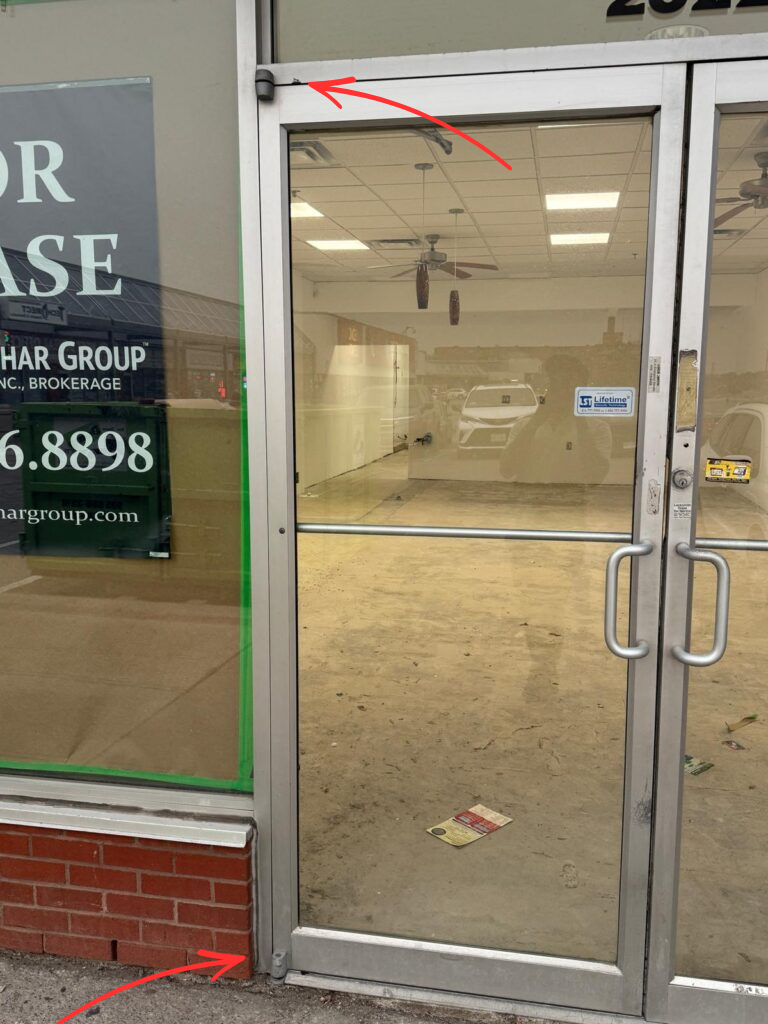
To understand why continuous hinges have become the standard on high-traffic commercial doors, you first need to understand how a traditional pivot hinge carries weight.
A pivot hinge system typically uses just two points of contact: one at the top of the door and one at the bottom, sometimes with a single intermediate hinge added for extra support on heavier doors. Every time that door opens, the entire weight of the slab, which can be well over 200 pounds for a solid commercial door, gets concentrated onto those two or three small contact points.
This is what’s known in engineering terms as a “point load.” Over thousands of open-and-close cycles, that concentrated stress works exactly like you’d expect: it wears down the hardware, stretches the mounting screws, and gradually causes the door to sag on its frame. This is why so many commercial doors in older Toronto buildings start dragging on the threshold after a few years of heavy use, even when the door itself is still in good condition.
How to avoid it: If your commercial door sees frequent daily traffic, especially in a retail, office, or institutional setting, ask your installer about weight distribution before defaulting to a standard pivot setup. You can browse our full breakdown of commercial door hardware options to see what we typically recommend for different door types.
2. What Exactly Is a Continuous Hinge?
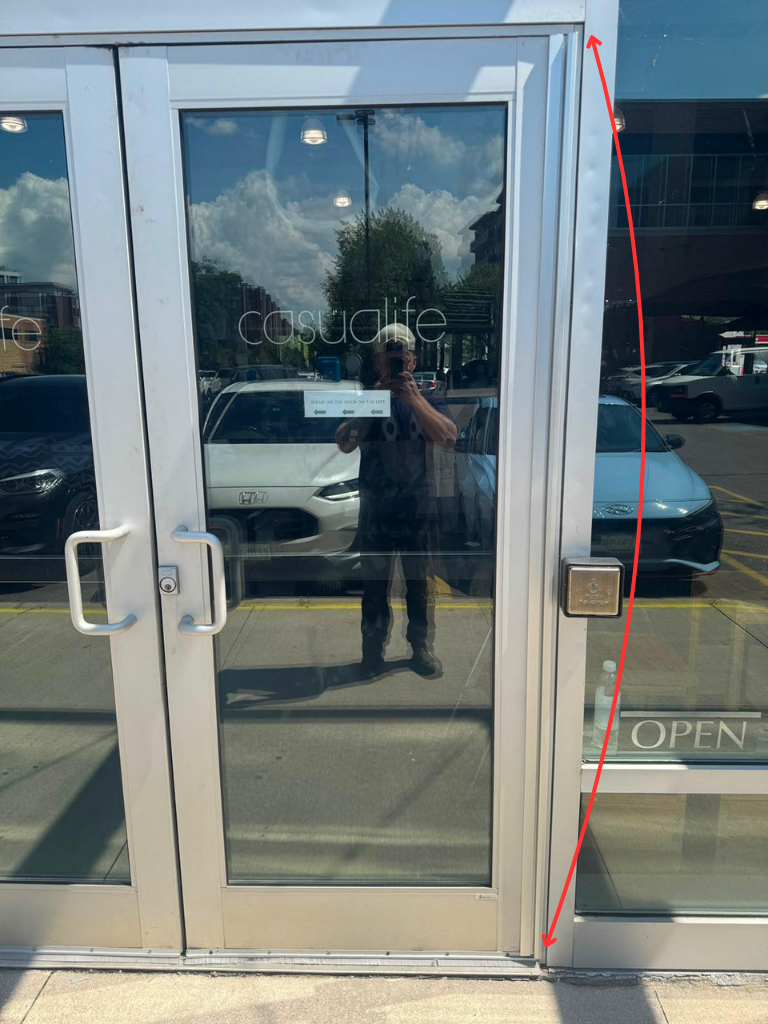
A continuous hinge, sometimes called a “piano hinge” because of its resemblance to the long hinge on a piano lid, runs the entire length of the door, from top to bottom, rather than relying on two or three isolated points.
Instead of concentrating the door’s weight onto a handful of small contact points, a continuous hinge spreads that same weight evenly across dozens of interlocking knuckles running the full height of the door. Most commercial-grade continuous hinges are made from extruded aluminum or stainless steel, and many use a gear-driven or channel design rather than a simple pin-and-knuckle setup, which further reduces friction and wear.
The result is a door that swings smoothly for a much longer period of time, without the gradual sag that plagues pivot-hung doors.
3. Weight Distribution: The Real Difference Maker
This is the core mechanical difference, and it’s worth spelling out clearly because it’s the reason continuous hinges cost more upfront but save money over the life of the door.
| Factor | Pivot Hinges | Continuous Hinges |
|---|---|---|
| Weight distribution | Concentrated at 2–3 points | Spread across full door height |
| Typical wear pattern | Sagging, dragging within 2–5 years on high-traffic doors | Minimal sag even after years of heavy use |
| Ideal door weight | Lighter to mid-weight doors | Heavy, high-traffic, or oversized doors |
| Adjustment needs | Frequent re-alignment | Rarely requires adjustment |
| Upfront cost | Lower | Higher |
| Long-term maintenance cost | Higher, due to repeat callbacks | Lower, due to reduced wear |
| Best suited for | Low-traffic interior doors | Exterior entrances, high-traffic commercial doors, storefronts |
This table reflects general industry patterns we see across commercial properties in Toronto and the GTA, not a guarantee for every specific door. The right choice always depends on door weight, traffic volume, and exposure to weather.
4. How Toronto’s Climate Extremes Affect Hinge Performance
This is the part of the conversation that often gets skipped in generic guides, and it matters a great deal here specifically.
Commercial doors in Toronto and the GTA don’t just deal with daily foot traffic; they deal with temperature swings from -20°C in January to over 30°C in the middle of summer. Metal expands and contracts with those swings, and every mechanical connection point in a hinge system is a potential source of movement, corrosion, or fatigue over time.
Pivot hinges, with their smaller number of contact points, tend to show this stress faster. A pivot pin that’s already carrying a concentrated load will wear out noticeably quicker when it’s also expanding and contracting through a Canadian winter-to-summer cycle. Continuous hinges, because the load and the thermal stress are distributed across the full length of the door, handle these swings with far less cumulative wear.
We see this play out most often on exterior storefront doors and building entrances that face west or south, where direct sun exposure adds another layer of thermal cycling on top of the seasonal swing.
5. Security and Vandalism Resistance
For commercial properties, a hinge isn’t just a mechanical component. It’s part of your building’s security envelope.
Pivot hinge doors have exposed hardware at the top and bottom of the door, which, on older or lower-grade systems, can sometimes be manipulated or pried with the right tools. Continuous hinges, by design, run the full length of the door and are much harder to access or tamper with from the exterior, since there’s no exposed gap or single weak point to target.
This is one of the reasons continuous hinges have become the default choice for schools, retail entrances, and multi-unit residential buildings across the GTA, where security and vandalism resistance are just as important as smooth operation.
6. Key Terms Worth Knowing
To help make sense of hardware quotes and specs, here are a few terms we use often when discussing commercial door hinges:
Knuckle: The individual interlocking segments along the length of a continuous hinge that allow it to bend and swing.
Point Load: The concentration of weight or force onto a small, isolated area, such as the pin of a pivot hinge, rather than being spread across a larger surface.
Gear-Driven Hinge: A type of continuous hinge that uses interlocking gear teeth instead of a simple pin, further reducing friction and wear over time.
Frame Reinforcement: Additional structural backing installed inside a door frame to support the increased mounting hardware of a continuous hinge system.
Cycle Rating: A rating, often listed as a number of open-close cycles, that indicates how many times a hinge is expected to function before it needs replacement or major maintenance.
7. Where Continuous Hinges Make the Most Sense
Continuous hinges aren’t automatically the right choice for every commercial door, and we’ll tell you that directly rather than upselling every client on the most expensive hardware available.
They tend to make the most sense for:
- High-traffic entrances, such as retail storefronts, office lobbies, and school entrances
- Heavy doors, including glass storefront systems, solid wood commercial doors, and fire-rated doors
- Exterior doors exposed to Toronto’s full seasonal temperature range
- Buildings where security and vandalism resistance are a priority
- Properties looking to reduce long-term maintenance callbacks
For lighter interior doors with low daily traffic, such as a back office or a storage room, a well-installed pivot hinge can still perform reliably for years. The key is matching the hardware to the actual demands the door will face.
8. Why Professional Installation Matters
Even the best continuous hinge on the market will underperform if it’s installed incorrectly. Because these hinges run the full length of the door and frame, they require precise alignment, proper frame reinforcement in many cases, and correct fastener spacing to distribute weight the way they’re designed to.
We’ve been called out to commercial properties across Toronto and the GTA where a continuous hinge was installed without the frame reinforcement it needed, which defeats much of the purpose of upgrading in the first place. The hardware was right. The installation wasn’t.
How to avoid it: Confirm with your installer whether your frame needs reinforcement before a continuous hinge is added, particularly on older commercial buildings where the original frame may not have been built with this hardware in mind.
Why Choose Revitalize Windows & Doors Inc
We’ve spent years working on commercial door hardware across residential complexes, retail plazas, office buildings, and institutional properties throughout Toronto and the GTA. We understand that a commercial door isn’t just an entrance; it’s a piece of daily-use equipment that affects safety, security, and the first impression your building makes.
Our approach focuses on matching the right hardware to the actual demands of your door, not simply recommending the most expensive option available. Whether you’re dealing with a sagging pivot-hung door or planning hardware upgrades for a new commercial build, we’ll walk you through what makes sense for your specific situation before any work begins.
How We Can Help You Today
- Assessment of existing commercial door hardware and wear patterns
- Continuous hinge supply and installation for storefronts, offices, and institutional buildings
- Frame reinforcement for heavy-duty hardware upgrades
- Pivot hinge repair and adjustment for lower-traffic doors
- Ongoing maintenance plans for high-traffic commercial entrances
Curious what continuous hinges look like on real commercial properties across the city? [See examples of our commercial door installations across Toronto and the GTA] (insert your commercial door gallery page URL here) to get a sense of the finished results.
Frequently Asked Questions
Are continuous hinges more expensive than pivot hinges? Yes, typically. The upfront cost is higher because of the materials and length of hardware involved, but the reduced maintenance and longer lifespan often make continuous hinges more cost-effective over the life of a high-traffic commercial door.
Can a continuous hinge be retrofitted onto an existing commercial door? In many cases, yes, though it often requires frame reinforcement, especially on older buildings across Toronto and the GTA that weren’t originally built with this hardware in mind.
How long do continuous hinges typically last on a commercial door? With proper installation, continuous hinges are commonly rated for well over a million open-close cycles, which translates to many years of reliable use even on high-traffic entrances.
Do continuous hinges help with energy efficiency? Indirectly, yes. Because they keep the door properly aligned within the frame over time, continuous hinges help maintain a consistent seal, which reduces drafts compared to a sagging pivot-hung door.
Is it worth upgrading from pivot to continuous hinges on an existing door? It depends on the door’s traffic volume and current condition. For low-traffic interior doors, it’s often not necessary. For high-traffic exterior entrances that are already showing signs of sag, it’s usually a worthwhile long-term investment.
Ready to Talk About Your Commercial Door Hardware?
If your commercial door is dragging, sagging, or simply due for an upgrade, we’re happy to take a look and give you an honest recommendation—not just the most expensive option on the shelf. For commercial properties across Toronto and the GTA, you can also explore our commercial door services or learn more about our commercial door repair services in Toronto and the GTA to see the full scope of what we handle.
Contact us directly to request your free quote and we’ll help you figure out exactly what your building’s doors need.


Leave a Reply