
Why Does My Door Let In Drafts? A Toronto Homeowner’s Guide to Finding and Fixing the Leak
It’s a November evening, the furnace is running, and you can still feel a thin stream of cold air sliding across the floor. You follow it, and sure enough, it’s coming from the front door. Or the back door. Or that sliding patio door you’ve been meaning to look at since last winter.
“Why does my door let in drafts?” is one of the most common questions we hear from homeowners across Toronto and the GTA, especially once the first real cold snap rolls in off Lake Ontario.
The short answer: a door lets in drafts when something is no longer sealing the gap between the door and its frame. That something is usually worn weatherstripping, a damaged door sweep, a threshold that’s out of adjustment, or a door that has shifted out of alignment. The good news is that most drafty doors don’t need to be replaced. They need to be diagnosed and repaired.
Below, we’ll cover every common cause, how to find the leak, and what you can fix yourself.
Why Drafty Doors Are Such a Big Deal in Toronto and the GTA
Our climate is hard on doors. Toronto and the surrounding GTA go through dozens of freeze-thaw cycles every winter, and wind off the lake finds every weakness in a home’s exterior.
Those temperature swings make materials expand and contract. Wood doors swell and shrink. Rubber and foam seals get brittle. Metal thresholds loosen. A door that sealed perfectly when it was installed slowly starts to leak.
A drafty door makes your furnace work harder and can cause frost and moisture damage around the frame. In older neighbourhoods like Leslieville, the Annex, and Roncesvalles, where many homes still have decades-old doors, drafts usually mean the seals reached the end of their life a long time ago.
How to Find Where the Draft Is Coming From
Before you fix anything, you need to know exactly where the air is getting in. These four tests don’t require any special tools.
1. The hand test. On a cold, windy day, slowly run the back of your hand around the edges of the closed door: along the top, down both sides, and across the bottom. The back of your hand is more sensitive to temperature than your palm, so you’ll feel the cold spots.
2. The incense test. Move a lit incense stick slowly around the door’s edges. Where the smoke flickers or gets pulled sideways, you’ve found a leak.
3. The paper test. Close the door on a sheet of paper. If you can slide it out easily with no drag, the seal at that spot isn’t making proper contact. Repeat along the sides, top, and bottom.
4. The daylight test. During the day, turn off the entryway lights and look at the door from inside. If you can see daylight around the edges or under the bottom, air is coming through those same gaps.
Once you know where the draft is, the cause usually becomes obvious.
The 8 Most Common Reasons Your Door Lets In Drafts
1. Worn, Compressed, or Missing Weatherstripping
This is the number one cause we see. Weatherstripping is the flexible seal lining the door frame that presses against the door when it closes. It might be foam-filled vinyl, rubber bulb, silicone, or the fuzzy pile strip found on sliding doors.
Over time it gets crushed flat, cracks, or falls out of its groove, and can’t fill the gap anymore. If you felt cold air along the sides or top of the door, this is the likely culprit.
2. A Damaged or Missing Door Sweep
The door sweep is the strip on the bottom of the door that closes the gap above the threshold. It drags across the threshold every time the door opens and closes, so it eventually wears down, tears, or pulls loose. Kids, pets, boots, and snow speed up the process.
If you can see light under the door or feel cold air at floor level, start here.
3. A Threshold That’s Out of Adjustment or Damaged
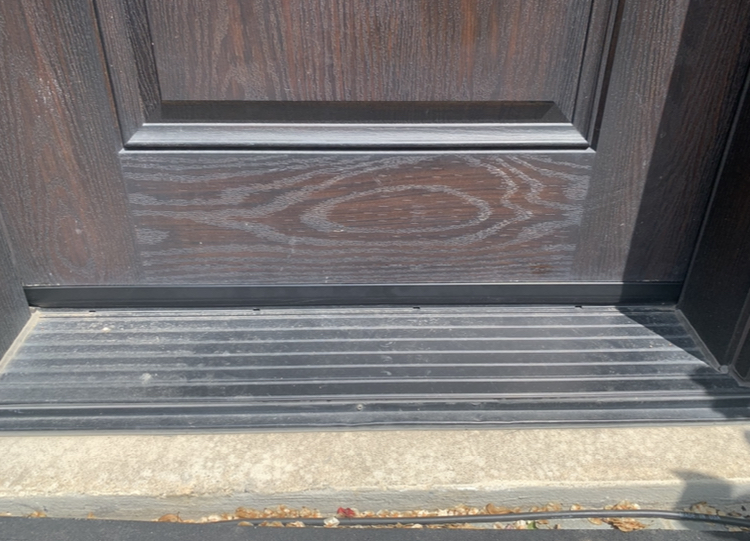
Many exterior doors in the GTA have an adjustable threshold, the strip on the floor beneath the door, with screws that raise or lower its centre so it meets the sweep. As homes settle and thresholds get stepped on thousands of times, they drop, loosen, or warp. Too low leaves a gap. Cracked or rotted lets in both air and water.
4. The Door Has Shifted Out of Alignment
Doors are heavy, and they sag on their hinges over time. Loose screws, worn hinges, and normal house settling pull the door out of square with the frame. One corner presses tightly against the weatherstripping while the opposite corner pulls away.
A classic sign is a door that rubs at the top on the latch side and has become harder to lock.
5. The Latch and Strike Plate Aren’t Pulling the Door Tight
The strike plate is the metal plate on the frame where the latch catches, and its position decides how firmly the door compresses the seals. If it’s slightly off, the door will latch but won’t seal. You’ll often feel a little play if you push and pull on the closed door.
6. Gaps Around the Frame and Trim
Sometimes the door seals fine and the draft comes from around the frame: cracked exterior caulking, gaps behind interior trim, or poorly insulated space between the frame and the wall.
7. Seasonal Swelling and Shrinking
Wood doors swell in humid summers and shrink in dry winters. A door that fits snugly in July can develop noticeable gaps by January. If your draft seems to come and go with the seasons, your weatherstripping probably needs to be thicker or better matched to the door.
8. Patio Door Problems: Worn Pile Strips and Dropped Rollers
Sliding patio doors are a draft magnet in many Toronto homes and condos. Their brush-like pile weatherstripping flattens with use, and when the rollers wear out, the door drops lower in the track and shifts away from its seals. If your patio door is drafty and hard to slide, those two problems are almost certainly connected.
It’s also worth checking any decorative glass inserts or sidelites. The seals around that glass can fail too, so run the hand test around those panels as well.
What You Can Fix Yourself (And What You Probably Shouldn’t)
We believe in being straight with homeowners, so here’s an honest breakdown.
Good DIY projects:
- Tightening hinge screws. If a screw just spins, replacing one screw in the top hinge with a longer one that reaches the wall framing can pull a sagging door back into place.
- Adjusting the threshold. If yours is adjustable, turn the screws a quarter turn at a time and use the paper test to check your progress.
- Replacing a simple door sweep. Many slide-on or screw-on sweeps can be swapped with basic tools, as long as you measure carefully and get the right profile.
- Recaulking exterior trim. Removing cracked caulking and applying a quality exterior sealant is a manageable weekend job when temperatures allow.
Where DIY often goes wrong:
- Weatherstripping replacement. There are dozens of profiles and sizes. Kerf-mounted weatherstripping has to match the slot in the frame and the gap exactly. The wrong product either won’t seal or makes the door hard to close and lock.
- Realigning a badly sagging door. Shimming hinges and adjusting the strike takes experience. It’s easy to fix one gap and create two more.
- Patio door roller replacement. Lifting a heavy glass panel out of its track is awkward and risky without help and the right parts.
If you’ve tried the basic fixes and the draft is still there, the problem is usually a combination of worn seals and alignment. That’s where a professional assessment pays off.
Do I Need a New Door?
This is the question behind the question for most people, and in our experience, the answer is usually no.
Most drafty doors we see across Toronto and the GTA have a perfectly solid slab and frame. What’s failed are the parts designed to wear out: weatherstripping, sweeps, thresholds, hinges, and rollers. Replacing those costs a fraction of a new door, and the result is often a door that seals as well as the day it was installed.
Replacement makes sense only when the slab is warped or the frame is rotted. At Revitalize Windows & Doors, we’d rather save you the cost of a full replacement whenever it’s possible.
How Much Does It Cost to Fix a Drafty Door?
We know this is what you really want to know, so let’s talk about it openly.
Cost depends on the cause and how many fixes are needed. A sweep replacement or threshold adjustment sits at the low end. Full perimeter weatherstripping with the correct profile sits in the middle. Combined repairs, like new weatherstripping plus hinge work and a new sweep, or patio door rollers plus new pile strips, cost more but are still well below the price of a new door and installation.
The fastest way to get a real number is to send us a few photos and describe where you feel the draft. We can usually give you a clear quote from there.
How We Fix Drafty Doors
When we come out to look at a drafty door, we don’t just stick on foam tape and leave. We test the door the same way we described above, find every point where air is getting through, and check the hinges, latch, strike plate, threshold, and frame. Then we fix the actual cause.
That might mean new weatherstripping matched to your door’s profile, a new sweep or bottom insert, compression foam, an adjusted or replaced aluminum threshold, or realigning the door so it closes tight. You can see the full range of options on our door and window weatherproofing services page.
As a mobile service, Revitalize Windows & Doors does the work right at your home or business, and most drafty door repairs are finished in a single visit.
Serving Homes and Businesses Across Toronto and the GTA
We work with homeowners, condo owners, and property managers from Etobicoke and North York to Scarborough, and across the GTA in Mississauga, Vaughan, Markham, and Richmond Hill. Whether it’s a century-old front door or a high-rise balcony door, the approach is the same: find the leak and fix the cause. Learn more about what we offer locally on our window and door repair Toronto page.
Stop the Draft Before Winter Settles In
A drafty door is easy to ignore until the first deep freeze. The good news is that it’s almost always fixable, usually without replacing the door.
If you’ve found a leak you can’t fix yourself, or you’d just like it done right the first time, the team at Revitalize Windows & Doors is ready to help. Send us a few photos and a quick description through our free quote and contact form, and we’ll get back to you with honest advice and a clear price. Let’s get your home warm and draft-free for the season ahead.

Leave a Reply