
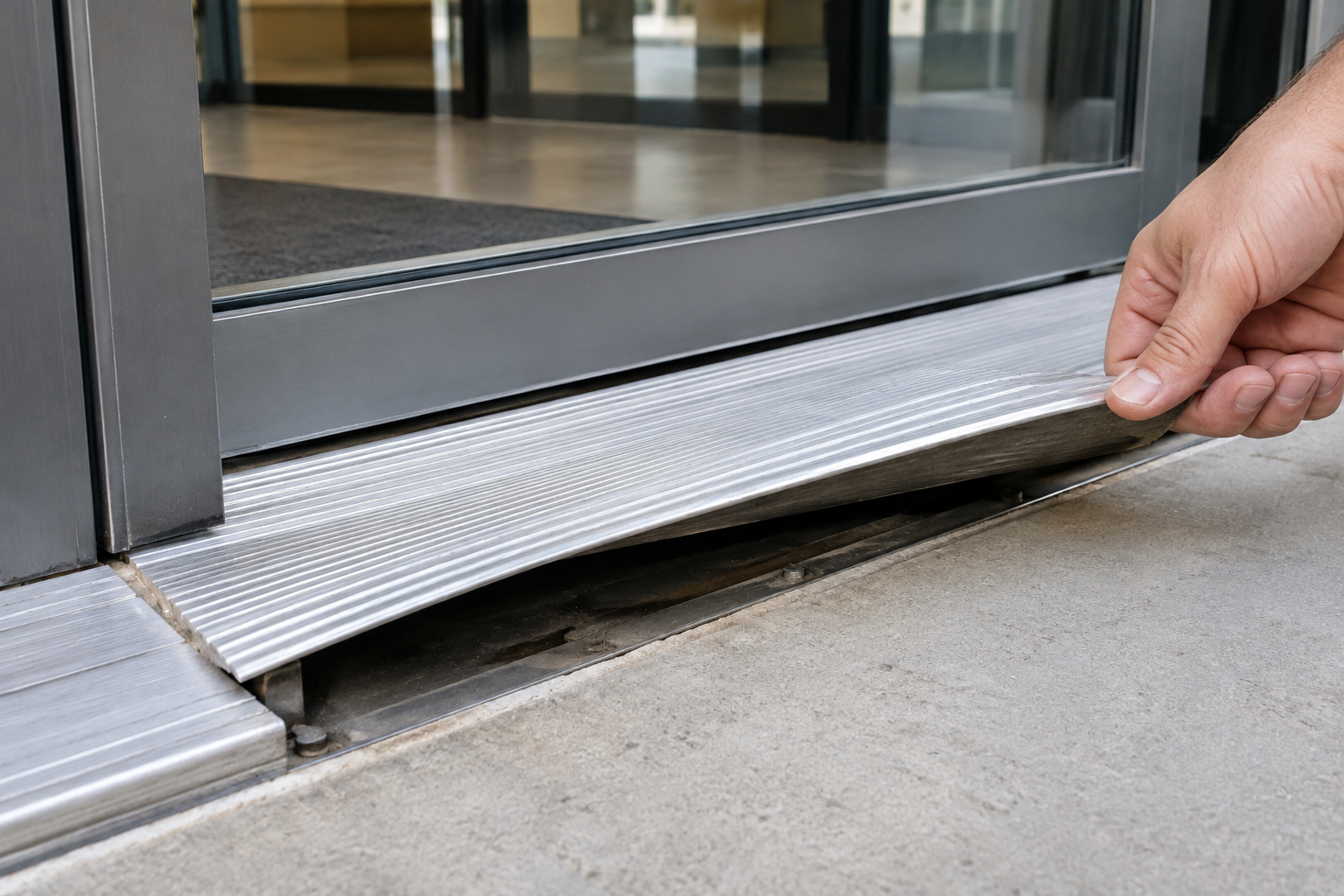
Why Is the Threshold on My Commercial Door Lifting Up?
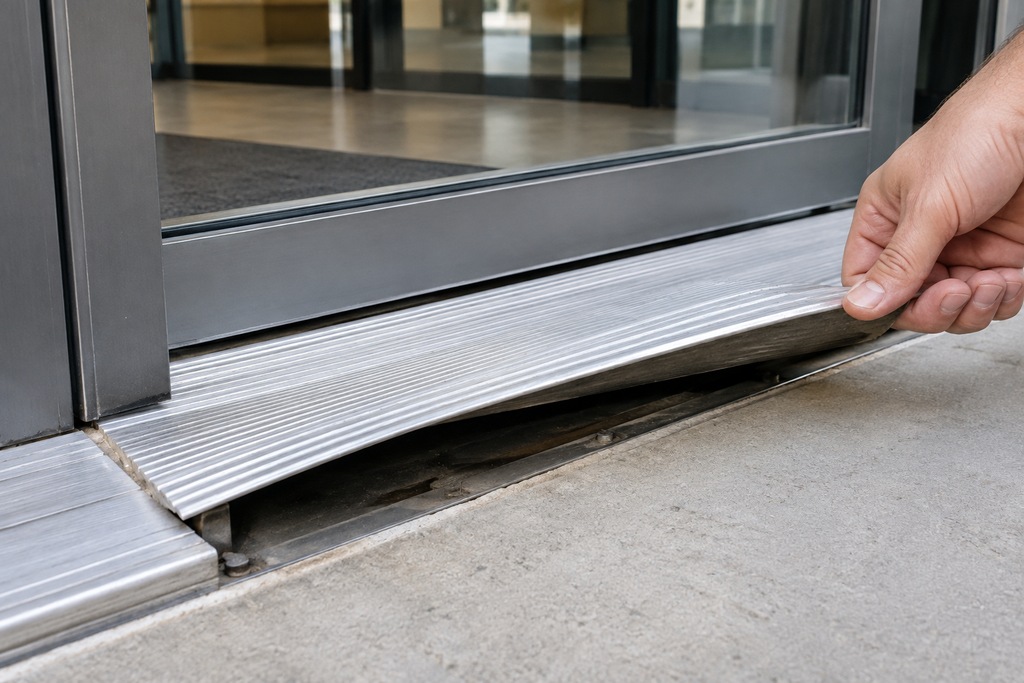
You unlocked the front entrance this morning and something looked off. The metal strip at the bottom of the doorway was sitting higher than it should. Maybe one end had popped up like a bent bottle cap. Maybe the whole thing was bowed in the middle. Or maybe a customer caught their toe on it and gave you a look that said everything.
A lifting threshold on a commercial door seems minor until it isn’t. It’s a trip hazard, it lets water and cold air into your space, and it can keep your door from closing and latching the way it should. So let’s answer the question honestly: why is it happening, how serious is it, and what can you actually do about it?
We repair commercial doors every week across Toronto and the GTA, from strip plaza storefronts to office lobbies to restaurant back entrances. The causes of a rising threshold are more predictable than most people expect, and once you know what to look for, you can usually tell what you’re dealing with in about five minutes.
What Does a Commercial Door Threshold Actually Do?
The threshold is the strip that sits across the bottom of your door opening, between the two sides of the frame. Most commercial thresholds are extruded aluminum, sometimes with a rubber or vinyl insert, and they’re fastened down into the concrete slab or subfloor below.
It does more than bridge the gap. A good threshold gives the door sweep or weatherstripping something to seal against, which keeps out rain, snow, slush, drafts, dust, and insects. It carries foot traffic, carts, wheelchairs, and dollies smoothly across the opening. It also helps keep the door frame square, which affects how the door swings and latches.
When the threshold lifts, all of those jobs start to fail at once. That’s why a small bump at floor level can turn into a bigger headache within a few weeks.
The Most Common Reasons a Commercial Door Threshold Lifts
Here are the causes we run into most often, roughly in order of how frequently we see them.
1. Frost Heave and Freeze-Thaw Cycles
This is the big one in our climate. Water gets into the soil and gravel beneath a slab or under the threshold itself. When temperatures drop, that water freezes and expands, pushing upward. Then it thaws, the ground settles, and the cycle repeats.
Toronto and the GTA see dozens of these freeze-thaw swings every winter, especially in March and April when we bounce above and below zero day after day. A threshold anchored to a slab that’s moving even a few millimetres will lift, twist, or buckle. If your threshold only misbehaves in late winter or early spring, frost movement is the prime suspect.
2. Loose, Rusted, or Failed Fasteners
Thresholds are held down with screws or anchors driven into concrete. Over the years, constant foot traffic, vibration from the door opening and closing, and moisture take their toll. Anchors loosen. Screws rust, especially where road salt gets tracked in. Plastic or lead shield anchors in old concrete can crumble.
Once even a couple of fasteners let go, the threshold has nothing holding that section down. It starts to flex, then lift at the edges, and then the next fastener gets all the stress. This cause is common and often the easiest to fix.
3. Water Trapped Underneath
Look closely at the seams where the threshold meets the frame and the floor. If the sealant has cracked or pulled away, water gets underneath. It sits against the concrete, corrodes the fasteners, and in winter freezes right under the metal.
Ice has real lifting power. We’ve pulled up thresholds in downtown Toronto buildings and found a thin sheet of ice sitting where there should have been a tight bed of sealant. Once the sealant fails, you’re basically running a small freeze-thaw experiment every night.
4. Thermal Expansion and Buckling
Aluminum expands when it heats up and shrinks when it cools. A long threshold, like those on double doors or wide storefront openings, can grow enough in summer sun to push against the frame ends. If it doesn’t have room to move, it buckles upward in the middle.
You’ll often see this on south or west-facing entrances that bake in the afternoon. The threshold looks fine in January and bowed in July. That’s a good clue.
5. Slab Settlement or Shifting Substrate
Sometimes the threshold isn’t the problem; the floor is. A concrete slab that has settled, cracked, or shifted will pull the threshold out of position. This is more common near older buildings, loading areas, and anywhere drainage has been an issue over the years.
If you see cracks in the concrete running toward the doorway, or the sidewalk in front of the entrance sits higher or lower than it used to, the movement is probably coming from below.
6. Door and Frame Movement
A door that has dropped on its hinges, or a frame that has shifted, changes how pressure is distributed across the bottom of the opening. The door might rub or drag. Heavy-use doors, like those on busy retail stores or restaurants, can wear hinges and closers quickly, and the resulting sag can push on the threshold.
Impact damage matters too. Pallet jacks, delivery carts, and even a snowplow nudging the doorway can bend a threshold out of shape in a single hit.
7. Installation Problems from the Start
We’ll be honest here, because it comes up more than anyone likes to admit: some thresholds were never installed well. Too few fasteners, no proper sealant bed, a threshold that wasn’t leveled on the slab, or no expansion allowance. These issues can sit quietly for a few years and then show up as a lifting problem after a couple of rough winters.
How to Figure Out What’s Causing It
You don’t need tools for a first look. Walk through these checks:
- Press down on the raised area. If it flexes or clicks, the fasteners underneath are loose or gone.
- Look at the sealant. Gaps, cracks, or dark staining around the edges point to water getting underneath.
- Check the timing. Does it get worse in late winter? Think frost. Worse in summer? Think expansion.
- Inspect the concrete. Cracks, uneven height, or a slab that slopes toward the door suggest settlement.
- Open and close the door. If it drags, rubs, or doesn’t latch cleanly, the frame or hinges may be involved too.
- Look for rust. Orange stains near the screw heads tell you moisture has been sitting there for a while.
If you answer “yes” to more than one of these, you’re likely dealing with a combination of causes. That’s very normal. Most lifting thresholds we see have two things going on, like loose fasteners plus failed sealant.
Is a Lifting Threshold Actually a Problem?
Short answer: yes, and it’s worth dealing with sooner rather than later.
It’s a trip hazard. Even a 6 mm lip can catch a toe, a cane, or the front wheel of a cart. For a business open to the public, that’s a liability concern. Accessible entrances also have height limits for thresholds, and a lifted one can push you out of compliance with barrier-free requirements. If you manage a building, it’s worth checking what applies to your property.
It compromises your seal. When the door sweep can’t make full contact, you get drafts and moisture. In a Toronto winter, that means higher heating costs and a cold spot right at your entrance. In summer, it means bugs and conditioned air leaking out.
It can affect security. If the door no longer closes squarely, the latch and deadbolt may not engage fully. That’s not something you want to discover after hours.
It gets worse on its own. Water keeps getting in, fasteners keep loosening, and metal keeps fatigue-bending. Waiting rarely makes the repair cheaper.
Can You Fix It Yourself?
Sometimes, yes. Here’s where we draw the line.
Reasonable DIY fixes:
- Cleaning out debris, dirt, and ice-melt residue from under and around the threshold.
- Tightening visible screws that have simply backed out, if the concrete is still sound.
- Re-sealing the edges with a quality exterior-grade sealant after cleaning and drying the area.
These steps can help if the problem is minor and caught early. Just be careful not to over-tighten into weak concrete, since that can crack it further.
When DIY usually doesn’t work:
- The threshold is visibly bent, bowed, or twisted. Hammering it flat rarely lasts, and it can damage the finish and the frame.
- Anchors spin in the concrete and won’t grip.
- There’s a gap between the threshold and the slab you could slide a coin into.
- The door no longer latches or the frame looks out of square.
- The concrete is cracked or heaving.
At that point, you’re not just fixing a threshold. You’re sorting out why it moved, and a repair that ignores the cause will fail again, often in the next winter.
One more honest note: please don’t shim under a lifted threshold with scrap material and call it done. We see this often, and it hides the problem while letting moisture collect underneath.
What a Proper Threshold Repair Looks Like.
When a commercial door threshold comes to us, here’s the general process:
- Assess the cause. We check the slab, fasteners, sealant, door alignment, and hardware to find out why the threshold moved.
- Remove the threshold. This lets us see what’s actually underneath, including trapped water, corrosion, or crumbling concrete.
- Correct the base. Depending on what we find, that might mean clearing and drying the area, repairing minor concrete damage, or adjusting for level.
- Re-secure or replace. If the threshold is straight and undamaged, it can often be reinstalled with fresh anchors and a new sealant bed. If it’s bent, corroded, or fatigued, we replace it with a new one sized to your opening.
- Seal and adjust. We reseal the perimeter and then check the door sweep, hinges, closer, and latch so the whole entrance works together.
If your door’s hardware is also tired, such as worn closers, sagging hinges, or a latch that won’t catch, it makes sense to look at those at the same time. Our commercial door hardware repair and replacement services cover the full entrance, so you aren’t fixing one piece only to chase the next.
What Affects the Cost?
Because you’re probably wondering, here’s what moves the price up or down:
- Repair versus replacement. Re-securing an undamaged threshold costs less than supplying and fitting a new one.
- Size of the opening. Double doors and wide storefront entrances need longer, heavier thresholds.
- Condition of the slab. Concrete that needs patching adds time and materials.
- Door and hardware condition. If the door needs adjustment or parts on top of the threshold, the job grows.
- Access and timing. After-hours work, tight access, or urgent same-day service can change the quote.
Every entrance is different, so the most accurate answer comes from someone looking at it in person. We’d rather give you a clear number after seeing the problem than guess over the internet.
How to Keep a Threshold from Lifting Again
A few habits make a real difference, especially through a Toronto winter:
- Keep the area clean. Sweep out grit and slush regularly. Debris holds moisture against the metal.
- Watch your salt use. Heavy ice-melt accelerates corrosion on both aluminum and fasteners. Use it sparingly near the doorway.
- Check the sealant each fall. Cracked or peeling sealant is an easy fix before winter and a harder one after.
- Make sure water drains away. If puddles collect in front of the door, address the drainage rather than just the threshold.
- Don’t ignore small signs. A slight click underfoot or a tiny gap at one end is your early warning.
- Schedule a seasonal check. A quick inspection in spring and fall, especially for high-traffic entrances, catches problems while they’re small.
When Should You Call a Professional?
If the threshold is flexing underfoot, visibly raised, or causing the door to drag or fail to latch, it’s time to call someone. The same goes if you’ve already tightened things up and the problem keeps returning. That usually means something deeper is going on.
For businesses and property managers, we’d also suggest not waiting if customers or tenants have already noticed. A lifted threshold is the kind of thing that turns into an incident report.
Our team at Revitalize Windows & Doors works with business owners, property managers, and general contractors across Toronto and the GTA, and we’ve handled thresholds on everything from small shops to multi-tenant buildings. We’ll look at the whole entrance, tell you plainly what’s causing the problem, and give you options. If a quick re-secure will do the job, we’ll say so. If it needs a full replacement, we’ll explain why.
You can see everything we do across the city on our Toronto window and door repair page, or if you’d rather skip straight to the next step, request your free quote here and tell us what you’re seeing.
Quick Answers to Common Questions
Will the threshold keep lifting if I ignore it? Usually, yes. Moisture and movement tend to compound, so a small lift often becomes a larger one, and the surrounding door and frame can start to suffer.
Can a threshold be flattened and reused? Sometimes, if it’s only slightly bent and the metal isn’t fatigued. A threshold that has been bent and straightened more than once tends to fail again, so replacement is often the better long-term choice.
Is this a winter-only problem? No. Frost is a common culprit in the Toronto and GTA area, but thermal expansion in summer, loose fasteners, and failed sealant can cause lifting any time of year.
How long does a threshold repair take? Simple re-securing can often be done in a single visit. Replacements or jobs involving concrete repair may take longer, depending on materials and curing time.
Final Thoughts
A threshold that’s lifting is your entrance telling you something has moved, loosened, or let water in. Whether the cause is Toronto’s freeze-thaw cycles, tired fasteners, a settling slab, or an installation shortcut, the fix works best when it deals with the cause and not only the symptom.
Check the basics, keep the area clean and sealed, and don’t wait until someone trips. If you’d like a second set of eyes, Revitalize Windows & Doors is just a call or a quote request away, ready to get your entrance flat, sealed, and working properly again.

Leave a Reply